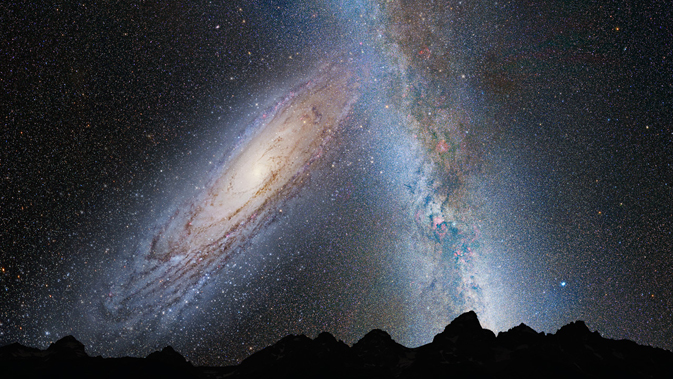
Let's skip 4.5 Billion Earth Years :
We are successfully travelled. Now we are in a huge ground, oh, there's something large in the Sky like a Galaxy or What!!! It is same like Milky way and it consists large stars and it is very bright.
That's the Andromeda Galaxy which is going to struck Milky way, our Galaxy after Billion Years. It's speed is 110km/s and it consists more stars than Milky Way. AndroMeda is made up of collection of 1 Trillion Stars. AndroMeda is also the Nearest Galaxy from Earth.
According to a Report, approximately after 4.5 Billion Years, Andromeda will collide with MilkyWay and will form Giant Elliptical Galaxy!!!
The Scientific Name of Andromeda Galaxy is M31.
What will Happen to our earth after colliding of MilkyWay?
According to Space Researchers, Nothing will happen to Earth because Earth is like a microorganism in the MilkyWay and If the Andromeda will Struck then the Earth will escape from the destruction.
After colliding of MilkyWay and the AndroMeda, what will be formed?
Usually, if you spoil a glass of water then the water will change itselfs shape randomly. Like that, If the collection of stars will collide then a new galaxy with new shape and new characteristics will be formed!!!
Which is larger between them?
AndroMeda's Diameter is across 220,000 Light Years but MilkyWay is not half of that also, MilkyWay is about 100,000 Light Years only. But powerful and massive stars and black holes are located in MilkyWay.
Which is older between MilkyWay and Andromeda Galaxy?
Andromeda is approximately aged between 10-11 Billion Years. The MilkyWay is formed about 13Billion Years ago. So in this case, the MilkyWay is older than Andromeda Galaxy. They both are located in Virgo Supercluster.
MilkyWay Galaxy
The Milky Way is the galaxy that contains our Solar System, with the name describing the galaxy's appearance from Earth: a hazy band of light seen in the night sky formed from stars that cannot be individually distinguished by the naked eye.
Andromeda Galaxy
The Andromeda Galaxy, also known as Messier 31, M31, or NGC 224 and originally the Andromeda Nebula, is a barred spiral galaxy approximately 2.5 million light-years from Earth and the nearest major galaxy to the Milky Way.
A Report by Fast Facts World Information Centre; https://fastfactsworld.blogspot.com
Wawwww!
ReplyDelete